OlfactoryAI
Bio-inspired AI for accurate odor perception prediction and the design of sustainable alternatives for the fragrance industry.
Contact us

Bio-inspired AI for accurate odor perception prediction and the design of sustainable alternatives for the fragrance industry.
Contact us
Power of AI in the Fragrance Industry

NYLIX is a revolutionary graph neural network engineered to replicate the human olfactory system. By unraveling the complexities of how the brain perceives scents, NYLIX possesses an extraordinary ability to predict aromas and fragrances with remarkable accuracy. Trained on a comprehensive dataset of over 6,000 molecules, it offers unparalleled insights into the intricate world of fragrances. Positioned at the forefront of olfactory science and artificial intelligence, NYLIX precisely identifies the probable scent profile of each molecule, enabling an unprecedented level of olfactory exploration. Embrace the future of scent design with NYLIX.
Discover the innovative capabilities of NYLIX through its core features.
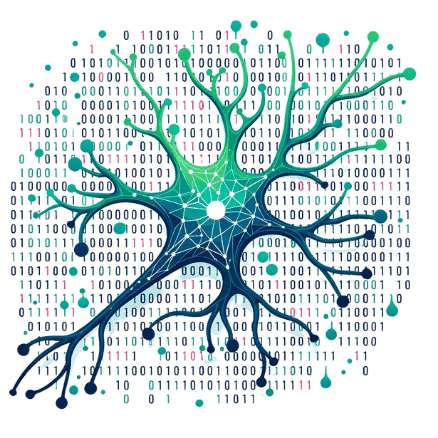
The Foundation of NYLIX is built on the GNN technology that is used to find a molecules aroma.

NYLIX reduces the amount of work involved in identifying molecule scents.

NYLIX can identify eco-friendly alternatives, helping industries become more sustainable and environmentally responsible.

NYLIX is able to find molecules scents in minutes.
Discover the milestones that define our story. From the industry mentions that validate our progress to over roadmap guiding our next steps, we’re driven by innovation and purpose.
Explore how each achievement and plan shapes a brighter future for our startup and those we serve.
Our contribution to olfaction modeling is highly valued, and our project has been selected as one of the top six out of a total of 111 applicants. This project is based on our journey to model olfaction, the least understood human sense. 3 years ago, we started our research, and along the way our research has yielded exciting results on the application of protein language models and graph neural networks in olfactory coding.
The article discusses recent advances in understanding olfactory receptors through neural networks. A team from the Institut de Chimie de Nice has developed a predictive model using data from the past 25 years. The model uses Graph Neural Networks (GNNs) to analyze over 46,000 odorant-receptor pairs. The new model can predict interactions between all known odorants and receptors, potentially extending beyond olfaction to pharmacology by targeting ORs involved in diverse metabolic functions and in cancer cells.
The article describes the capabilities of the Molecule to Olfactory Receptor database (M2OR), which facilitates the exploration of interactions between odorant molecules and olfactory receptors. M2OR contains data from 75,050 bioassay experiments, covering 51,395 distinct OR-molecule pairs, and provides insights into receptor activation patterns and molecular recognition. Advanced search options for specific molecules, receptors or experimental conditions are offered by it.
The article discusses a collaboration between GDR O3 and Nez, focusing on the intricate procedure of olfactory perception. The paper discusses recent advances made by a team from the Université Côte d’Azur, which used artificial intelligence to decode the combinatorial odor code from olfactory receptors. This breakthrough involves a database of odor and receptor pairings, which could potentially lead to pharmacological applications by targeting olfactory receptors that also regulate various body functions and are present in cancer cells.
ACHEMS conference learning and sharing our work in olfactory receptors.
We are pleased to share that development of the new NYLIX Web App is currently in progress. This innovative platform will feature a streamlined, user-centric interface designed to enhance functionality and usability for our customers.Our planned launch is set for 2025. We look forward to delivering a superior digital experience and will keep you informed of key milestones as we approach the release.
Dataset 2.0 brings us new possibilities and innovative approaches for building our models. Completely rebuilt from the ground up, it opens new avenues for uncovering the relationships between molecules and their scents.
The second generation of our model improves the capabilities of our previous model.
Dataset 1.0 marks the beginning of our journey in developing advanced AI models. A clear and accurate dataset is essential for building effective AI systems. That’s why we prioritize meticulous collection and curation of vast amounts of open-source data. Each piece of data is carefully refined and structured to create the robust foundation used to train our models.
In 2020, we created our first AI model capable of detecting and interpreting molecular scents. This groundbreaking achievement was made possible by our meticulously crafted dataset. The current generation of our scent-detecting models delivers outcomes comparable to human perception. Our models decode the SMILES code of a molecule and map it to our extensive dictionary. Remarkably, this technology can even describe the scent of previously unknown molecules.
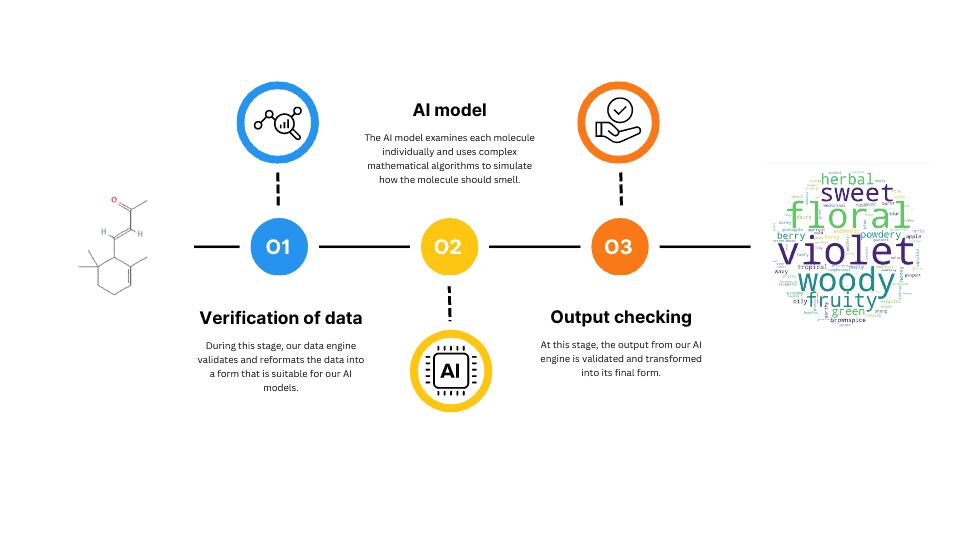
NYLIX receives a molecule represented as a graph, processes it through sophisticated probability calculations, and generates a comprehensive probability model depicting the molecule’s scent profile. This procedure reveals the olfactory signature inherent in the molecular architecture, effectively bridging the gap between molecular structures and perceivable scents. Through NYLIX, the exploration of scent identification and categorization becomes a quantifiable undertaking, unlocking new potential in perfumery, flavor sciences, and quality control sectors.